
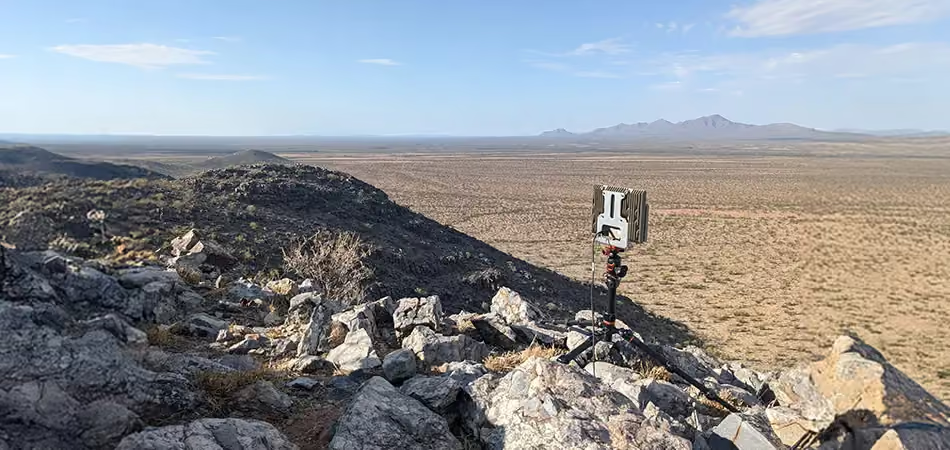
Defense Tech Signals (DFT) highlights Echodyne as a pioneer in metamaterials radar because it delivers high-performance, low size, weight, and power radars at the fraction of the cost and complexity of traditional systems. Echodyne developed patented MESA technology radar systems that deliver precision detection, classification, and tracking of aerial and ground threats in very compact and low cost packages which it makes it possible to rapidly scale counter-UAS defenses. Echodyne offers radar solutions that are ready to field now, filling critical gaps in defense and security modernization efforts and solves the radar affordability and scalability problem at exactly the moment when counter-UAS demand is skyrocketing.
Read the full Defense Tech Signals blog below.
Echodyne is developing a new class of radar using metamaterials, bringing electronically scanned array (ESA) performance in smaller, more deployable formats. Their proprietary Metamaterials Electronically Scanned Array (MESA) architecture uses standard circuit board fabrication, avoiding costly military-grade components, and can be fielded where traditional radars are too large, power-hungry, or expensive.
Founded in 2014 as a spin-out from Intellectual Ventures, Echodyne builds on metamaterials research developed with Duke University and UC San Diego. CEO Eben Frankenberg and CTO Dr. Tom Driscoll aimed to rethink radar by replacing traditional phased array hardware with structured materials that manipulate electromagnetic waves.
Early prototypes tested through the DHS Silicon Valley Innovation Program quickly moved from pilot to procurement, leading to early wins such as a $20M IDIQ with CBP and inclusion in the U.S. Army’s $191M Security Surveillance System (SSS) program.
Today, Echodyne designs dual-use radars for defense, national security, border security, airspace management, and advanced air mobility. Their focus: make radar small, affordable, and practical for real-world deployment, especially in places where traditional sensors are hard to justify.
Metamaterials are man-made materials built with tiny, carefully arranged structures that are smaller than the waves they affect. Instead of getting their special abilities from what they’re made of, they work because of how they’re built.
By changing the size, shape, and pattern of these structures, scientists can make waves bend, focus, or even disappear in ways that natural materials can’t.
Source: Wikipedia
1.4 kg sensor for short-range detection of drones, humans, and vehicles. Already deployed for Army base security and DHS border surveillance, often as modular kits augmenting tower-based sensors.
EchoShield – Low SWaP, Medium-range, Multi-mission Radar
Software-defined radar for base perimeters, convoy security, mobile SHORAD, and high-priority sites.
Echodyne’s design breaks the cost and SWaP barriers that have limited AESA deployment, enabling radar coverage for missions and units previously priced out. This opens the market well beyond traditional defense primes, particularly for dispersed and coalition operations
The counter-UAS fight didn’t blindside us. The Army saw it coming thirty years ago, when analysts warned that lethal drones, reconnaissance UAVs, and low-flying cruise missiles would challenge forward-deployed forces and fixed sites.
In response, the Army began modernizing short-range air defense (SHORAD), only to begin divesting programs in 1999-2000 in favor of “general-purpose” capabilities. Two decades later, the National Commission on the Future of the Army called that draw down a “modernization shortfall,” and ISIS drones proved the warning right.
Today, DoD calls unmanned systems an “urgent and enduring threat” to U.S. personnel, facilities, and assets. The Army’s Joint Counter-Small UAS Office sets doctrine, requirements, and training, yet other services have been slow to match that commitment. That structure may soon change.
The current draft of the FY2026 National Defense Authorization Act would dissolve the Army-led office within 60 days of enactment, shifting its functions, assets, and civilian workforce to the Office of the Under Secretary of Defense for Acquisition and Sustainment.
Regardless of who is in charge, the operational consensus is well understood. Layered defense demands high-end sensors like LTAMDS and SPY-6, paired with commercial low-SWaP radars such as EchoShield and EchoGuard for the short range fight. Combined with kinetic and non-kinetic interceptors and fielded in distributed networks, Echodyne can create multiple engagement points that are far harder to saturate.
The window to act is short. In the Indo-Pacific, vast distances and dispersed islands mean each unit must land with its own counter-UAS suite on day one. The fastest path forward is to field interoperable, off-the-shelf kits now, refine them in training and operations, and out-iterate adversaries before they adapt.
We’ve had the forecast for three decades. The rain is here. It’s time to start using our umbrellas instead of arguing about what color they should be.
The counter-UAS problem is a structural vulnerability across the force. Low, slow, small drones have slipped past traditional air defense and delivered decisive effects.
Even with proven systems, pushing enough sensors forward, tying them into C2, and training units outside the air-defense MOS to use them is difficult. Congressional language in the FY 2026 NDAA shows growing impatience: slow tech transition, weak integration at brigade-and-below, and uneven service buy-in.
Echodyne is one of the few companies with scalable radars already under contract with both the Army and DHS. Stop waiting for perfection. Field what works, now.

