
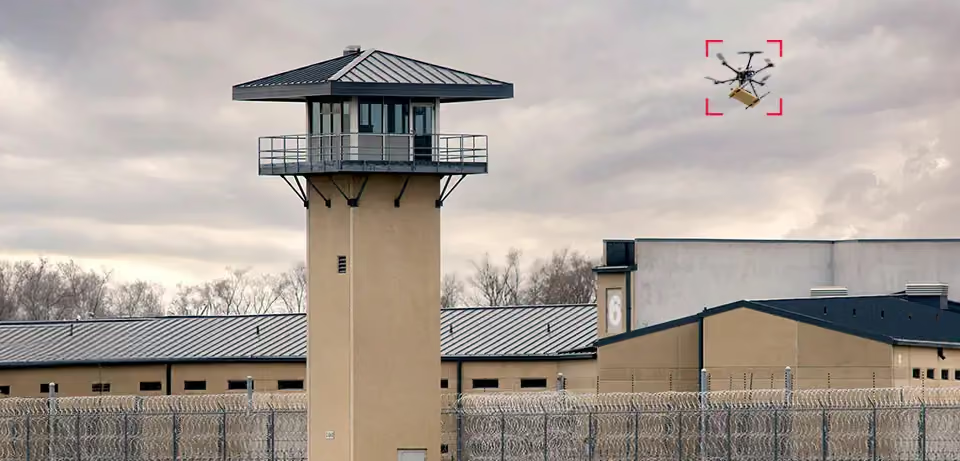
If you work in the prison system, evidence of drones delivering contraband to your facility has heightened your security concerns. Fortunately, recent technological advances have made high- performance drone detection systems much more affordable and accessible.
Correctional facilities face increasing threats from contraband deliveries via drones. Traditional methods like cameras can be ineffective, especially in poor weather or low-light conditions. Criminals exploit these weaknesses, often flying drones at night to avoid detection.
Many state agencies and private corrections providers have tried using RF sensors to detect drones. However, "dark drones" that do not emit detectable signals have become widespread. Additionally, criminals can use electronic measures like jamming to blind RF sensors.
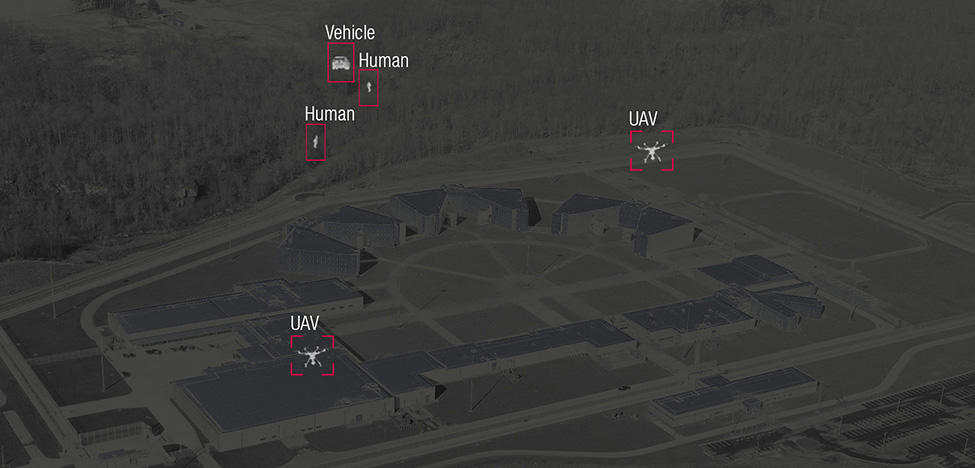
Drone detection radar is a critical component of a robust drone detection system. Unlike RF sensors, radar can detect all objects moving in the sky, regardless of whether they emit a radio frequency signal. Radar also operates effectively in all weather and lighting conditions, making it essential for night-time detection when many drone deliveries occur. Radar excels in tracking multiple drones simultaneously, crucial for identifying decoy drones used to divert attention from those carrying contraband.
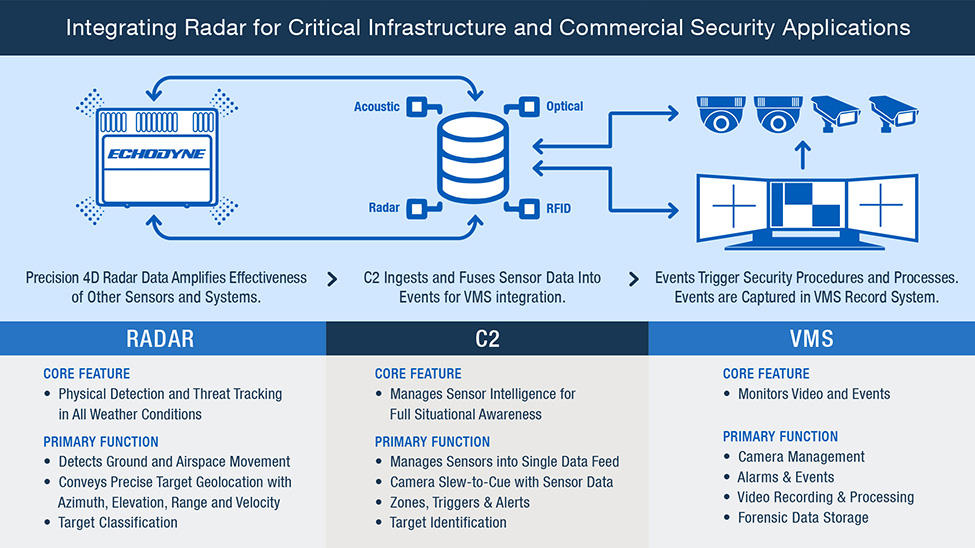
Radar works best when integrated into a layered drone detection and tracking system that includes multiple sensors. Technologically advanced radar for drone detection offers high performance object detection and tracking over extended ranges. Leveraging the additional capabilities of other sensors and systems enhances situational awareness and supports clear decision making.
Here is an example of multiple sensors, their key advantages and how they relate:
Both radar data and the behavior observed through the camera view can verify patterns of drone activity, aiding in strategic placement of sensors for better monitoring. Depending on the risk profile, and budget, advanced camera analytics and acoustic sensors may round out the stack. All sensors integrate into a command and control (C2) system and/or video management system (VMS) which serve as information consolidators, visualization mediums, and means to record threat activity.
Echodyne recently hosted a LinkedIn Live panel discussion on developing comprehensive drone detection and deterrence programs. The panel featured professionals including a deputy director of operations, drone coordinator, director of prison operations, and senior director for security operations and intelligence.
The discussion covered:
Implementing a multi-sensor drone detection system is crucial for maintaining security in correctional facilities. By combining technologies like radar, RF sensors, and cameras, you can create a robust defense against contraband deliveries. Collaborating with law enforcement and leveraging expert insights can further enhance your facility’s security posture.
For more detailed insights, check out the transcript of Echodyne's panel discussion on LinkedIn

