
Inexpensive to acquire, easy to operate, simple to hack, and straightforward to build, drones challenge current compliance frameworks, surveillance systems, and legislative control of the airspace. No matter how well-constructed the barriers or the density of fixed cameras, drones are easy to make invisible to nearly all terrestrial surveillance sensors.
Radar is the only sensor that detects and tracks all airspace movement, but most radars were not designed for the drone threat. Traditional systems were built for fixed-wing aircraft and large, slow-moving targets. Small UAS present an entirely different detection challenge: low radar cross-sections, variable flight paths, and the ability to hover in place.
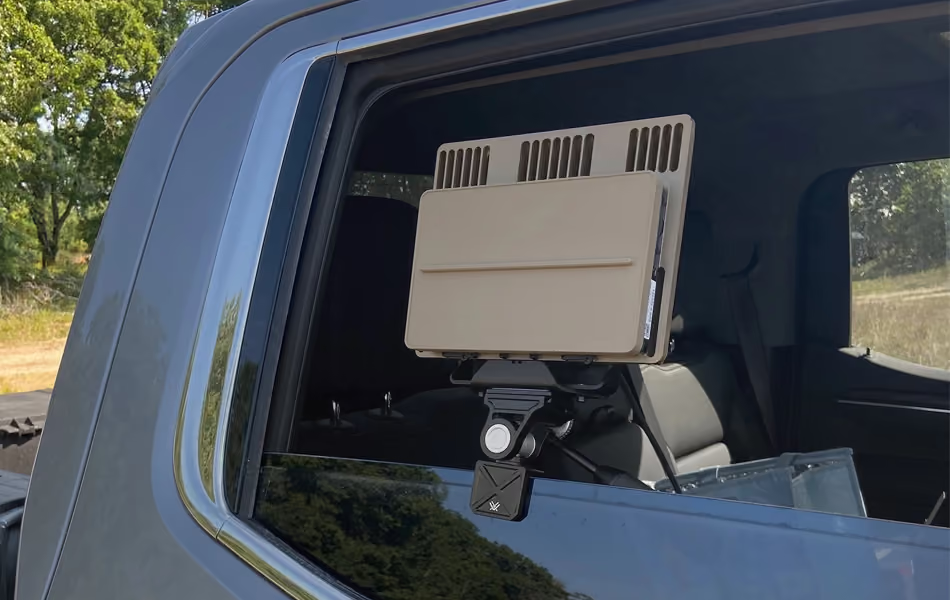
Echodyne's low-SWaP MESA® radars provide the technology edge for superior airspace situational awareness. Unlike mechanically scanned systems, MESA (Metamaterial Electronically Scanning Array) technology uses electronically steered beams to deliver wide-area coverage with the precision needed to detect, track, and classify small and slow-moving targets. Low SWaP design — Size, Weight, and Power — means these systems deploy rapidly, integrate into existing security architectures, and support on-the-move capabilities to extend field operations beyond fixed installations.
Situational awareness is the goal. Drones in the airspace are the problem. Radar is essential for a multi-layered solution but is absolutely critical when the threat is dark drones without RF signals. When the threat is intelligence and reconnaissance, Echodyne radars detect the propeller spin of hovering drones and direct security personnel to the exact location. Radar data is the foundation for airspace situational awareness.
Already in use across every U.S. federal agency, Echodyne radars are the primary sensor in dozens of multi-layered counter-drone solutions — providing the information advantage that makes the rest of the stack reliable.

